Targeted financial sanctions: the law
When the United Nations Security Council imposes financial sanctions on a person or entity, they take effect in South Africa immediately (section 26A of the FIC Act). From then on, nobody, not only accountable institutions, may acquire, use or deal with their property, or give them financial or other services (section 26B). In effect it is an asset freeze, and breaking it is a criminal offence. Only the Minister, or the FIC by delegation, can permit narrow exceptions such as basic living expenses (section 26C).
The FIC's sanctions list
The FIC publishes the targeted financial sanctions list. It is a copy of the UN Security Council's consolidated list, not a separate South African list, and it is updated within 24 hours of a change at the UN. You can search it online or download it as PDF, Excel or XML. Registered accountable institutions are subscribed to its email alerts.
Who and when to screen
Sanctions screening is not risk-based. The FIC's PCC 44A says to screen client information whatever the client's risk, for local and international transactions alike:
- Who: the client, its beneficial owners, anyone acting for or on behalf of the client, and the other parties to a transaction.
- When: when you take a client on, when you conduct a transaction, and every time the list is updated, re-screening all existing clients without delay.
- With what: name, ID number, date and place of birth, address and nationality, so a name alone doesn't decide a match.
You may screen by hand or with software. If you use a tool, you stay responsible and must be able to show it uses the FIC's latest list. Keep a record of every screening result.
What to do with a possible match
Most possible matches are someone else with a similar name. Compare every identifier you have: date of birth, ID or passport number and nationality. Record why you cleared it, or escalate it if you can't.
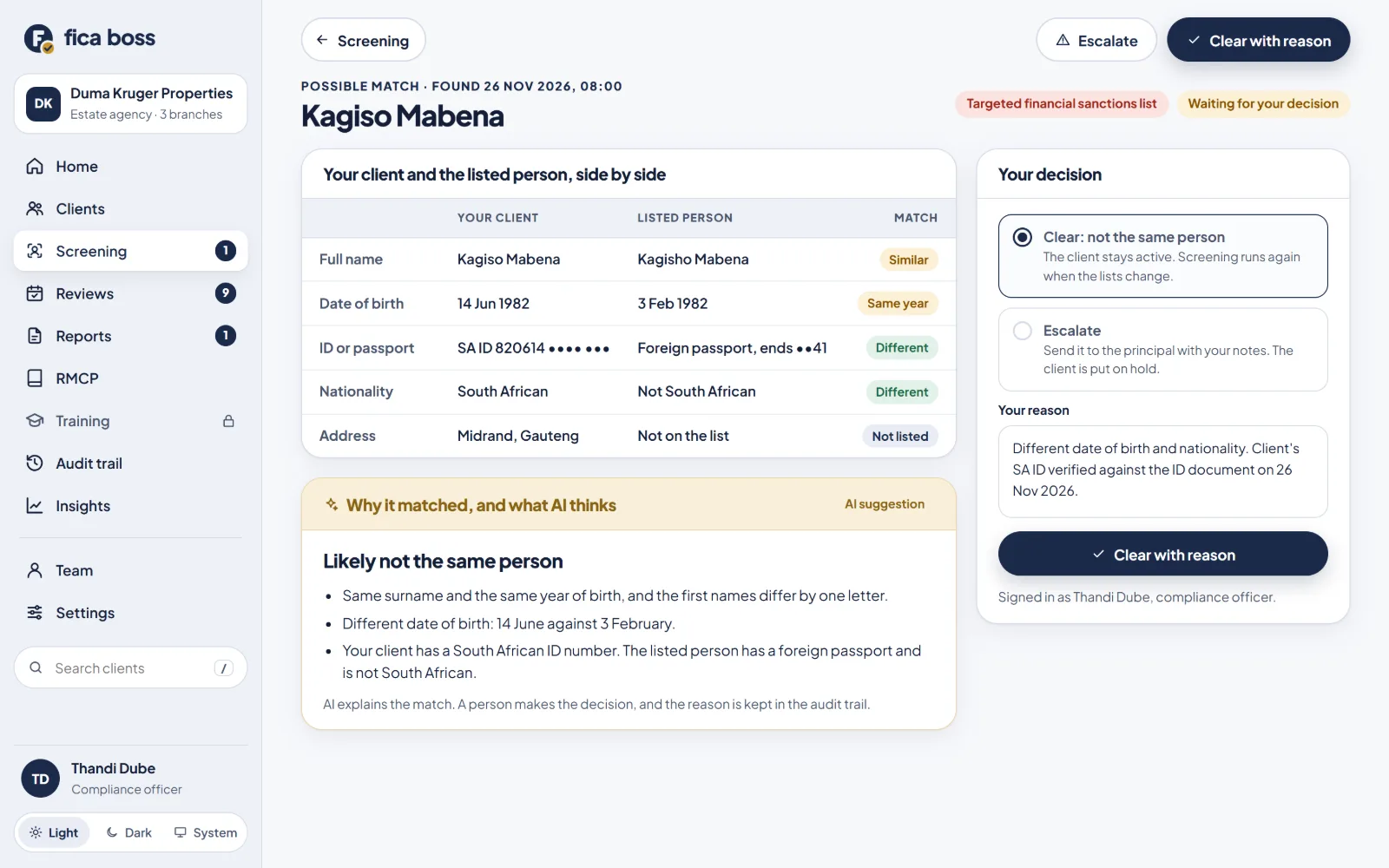
If the client is the listed person or entity:
- Freeze at once. Don't wait for the FIC. Don't take the client on and don't release any property.
- File a terrorist property report on goAML within 5 business days (section 28A), even if the transaction was only attempted.
- Report later attempts to transact as suspicious transaction reports.
Politically exposed persons
Since 31 December 2022, the FIC Act speaks of politically exposed persons (PEPs). A person who holds or has held one of these positions stays a PEP, with no time limit:
- Domestic PEPs (Schedule 3A): for example the President and Deputy President, ministers and deputy ministers, premiers and MECs, executive mayors, leaders of political parties, royal family members and senior traditional leaders, heads and finance chiefs of government departments and municipalities, senior executives of public entities, judges, ambassadors based in South Africa, senior military officers, and heads of international organisations.
- Foreign PEPs (Schedule 3B): people with a prominent public function in another country, such as heads of state or government, ministers, senior judges, senior executives of state-owned companies and high-ranking military officers.
- Family members and close associates (section 21H): a spouse or partner (current or previous), children and stepchildren and their partners, parents, and siblings and stepsiblings and their partners, plus known close associates such as business partners.
What to do when a client is a PEP
For a foreign PEP, always: get senior management approval before taking the client on, take reasonable steps to establish the source of wealth and the source of funds, and monitor the relationship more closely (section 21F). The FIC treats these relationships as high risk.
For a domestic PEP, take the same three steps when your RMCP assessment finds the relationship is higher risk (section 21G). A domestic PEP is not automatically high risk.
Record who approved or declined the relationship. The client is the main source of information about their status: a commercial database helps, but it doesn't protect you if it's wrong. Check PEP status again over time, and say in your RMCP how you identify PEPs.
Prominent influential persons
The 2022 changes also created prominent influential persons (Schedule 3C): the chairs, chief executives and finance chiefs of companies that supply goods or services to the state above an annual value that the Minister must set. When we checked, that value had not been set, and the FIC's guidance expects this category to start later.
- Financial Intelligence Centre Act 38 of 2001 (gov.za)
- General Laws (Anti-Money Laundering and Combating Terrorism Financing) Amendment Act 22 of 2022 (gov.za), FIC Act changes in force from 31 December 2022
- FIC: targeted financial sanctions and the sanctions list
- FIC PCC 44A: targeted financial sanctions obligations (29 February 2024)
- FIC: targeted financial sanctions manual (October 2026)
- FIC Guidance Note 7B: implementation of various aspects of the FIC Act (3 August 2026)