What an RMCP is
Section 42 of the Financial Intelligence Centre Act requires every accountable institution to develop, document, maintain and implement a programme for managing the risk of money laundering, terrorist financing and, since 31 December 2022, proliferation financing. It is called the Risk Management and Compliance Programme, or RMCP.
The RMCP is the centre of the risk-based approach. It sets out how your business assesses risk and how it carries out every FICA duty, from customer due diligence to reporting. When the FIC inspects you, it reads your RMCP first and then checks that you do what it says.
What it must cover
Section 42(2) lists what the RMCP must do or set out:
| Paragraph | What it covers |
|---|---|
| (a) | Identify, assess, monitor, mitigate and manage the risk that your products and services could be used for money laundering, terrorist financing or proliferation financing. |
| (b) | How you decide whether a person is a prospective client or a client. |
| (c) | How you make sure you never deal with anonymous clients or false names. |
| (d) | How you establish and verify identities. |
| (e) | How you check that future transactions fit what you know about the client. |
| (f) | The extra due diligence for companies, trusts and partnerships, including beneficial ownership. |
| (g) | Ongoing due diligence and account monitoring. |
| (h) | How you examine complex or unusually large transactions and unusual patterns, and keep written findings. |
| (i) | How you confirm client information when you doubt it, or after a suspicious transaction report. |
| (j) | How you carry out customer due diligence when you become suspicious during a relationship. |
| (k) | How you end a relationship when you can't complete customer due diligence. |
| (l) | How you find out whether a client is a foreign or domestic politically exposed person, or a prominent influential person. |
| (m) | Enhanced due diligence for higher-risk clients, and when simplified due diligence is allowed. |
| (n) | How and where records are kept. |
| (o) | How you recognise a reportable transaction. |
| (p) | Your reporting processes. |
| (q) | How the programme applies in foreign branches and subsidiaries. |
| (qA) | Group-wide programmes for branches and majority-owned subsidiaries, including information sharing. |
| (r) | How the programme is put into practice. |
| (s) | Anything else that is prescribed. |
If a paragraph doesn't apply to your business, the RMCP must say so and explain why (section 42(2A)).
Who must approve it
The board of directors, senior management, or whoever holds the highest authority in the business must approve the RMCP (section 42(2B)). The FIC's Guidance Note 7B adds that this approval can't be handed to a committee, and that what goes to the board must describe the programme fully rather than point to other documents. Changes need the same approval.
How the FIC suggests you build it
The FIC recommends three parts: identifying and assessing risk (including your risk appetite), mitigating it, and monitoring it. Start with a risk assessment of the whole business: your clients, products and services, the ways you deal with clients, and the places involved. Then decide how each kind of risk is rated and what extra steps a higher rating triggers.
For non-financial businesses and professions, such as estate agents, attorneys and trust and company service providers, the FIC's PCC 53 includes an RMCP template.
Keep it current
- Review it regularly (section 42(2C)), and when your business, your clients or the law change.
- Make it available to the staff who deal with clients and transactions (section 42(3)).
- Train your staff on it (section 43), and keep a record of who was trained on which version.
- Give the FIC a copy when it asks (section 42(4)).
A bill introduced in Parliament in May 2026 would add a duty to assess the risk of new products and technologies before launch. It is not law yet; check its progress before you rely on it.
How the RMCP builder in FICA Boss works
The RMCP builder in FICA Boss writes your programme from your own answers, and keeps it tied to how the platform actually runs.
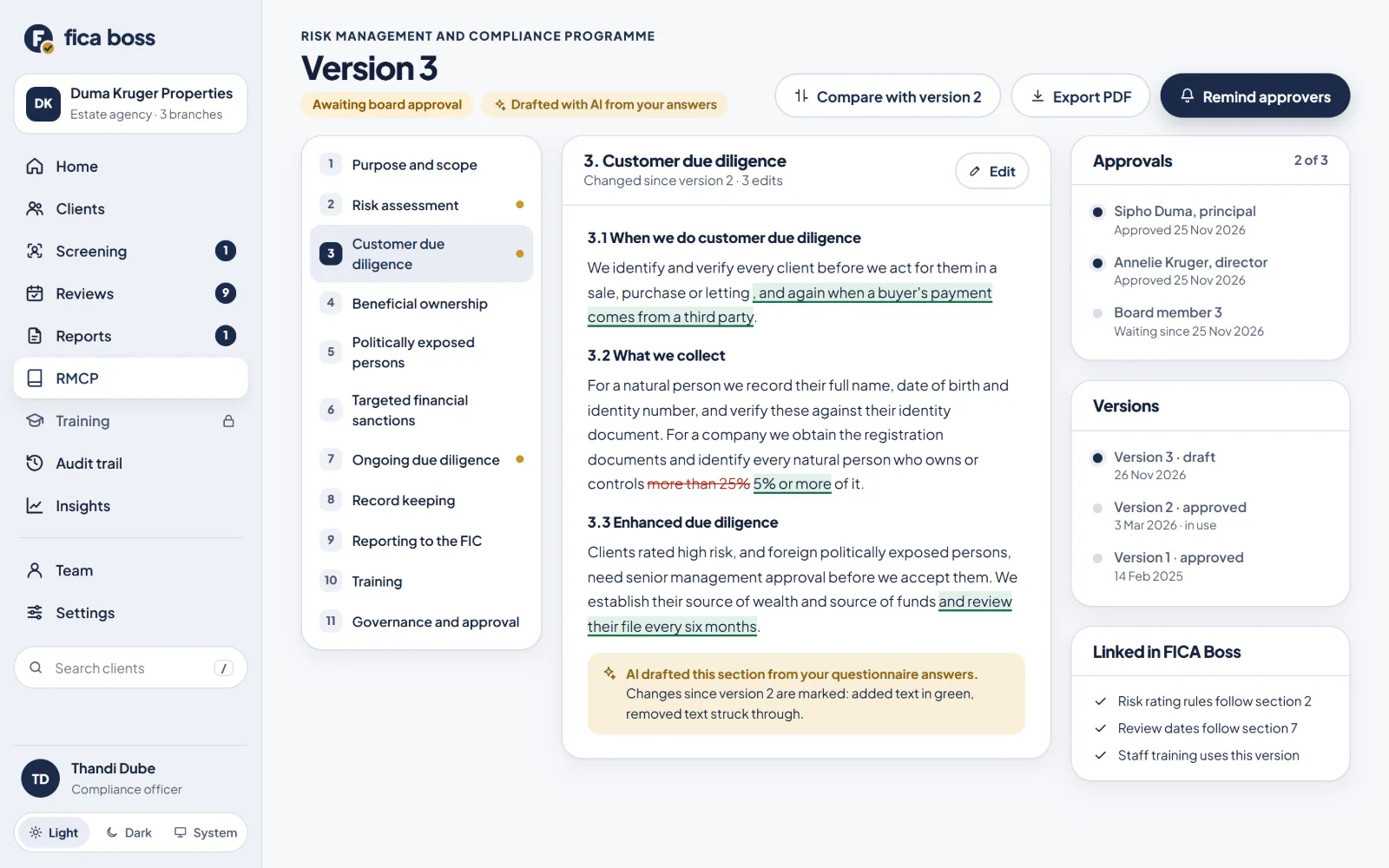
- Drafted from a questionnaire. AI drafts each section from your answers about your clients, services and channels. You edit and approve every word.
- Versions and approvals. Each version is kept, the changes since the last one are marked, and approvals are recorded with names and dates.
- Linked to the platform. Risk ratings, review dates and staff training follow the approved version.
- Financial Intelligence Centre Act 38 of 2001 (gov.za)
- General Laws (Anti-Money Laundering and Combating Terrorism Financing) Amendment Act 22 of 2022 (gov.za), FIC Act changes in force from 31 December 2022
- FIC Guidance Note 7B: implementation of various aspects of the FIC Act (3 August 2026)
- FIC PCC 53: RMCP guidance and template for non-financial businesses and professions (30 August 2022)
- Parliament: General Laws (Anti-Money Laundering and Combating Terrorism Financing) Amendment Bill B15-2026 (introduced 27 May 2026, not yet law on 26 November 2026)